文化三角
Polonnaruwa
波隆纳鲁沃是斯里兰卡的中世纪都城,也是文化三角最轻松惬意的一站——这座紧凑的世界遗产古城汇集了宫殿、佛殿与迦尔寺庄严绝美的岩雕大佛,平坦荫凉的小径将它们串联起来,最适合骑行游览。城边还有波光粼粼的十二世纪巨型水库"帕拉克拉马海",遗址间成群的斯里兰卡猕猴上蹿下跳,构成不容错过的完美一日。
When Anuradhapura fell to invaders in the 10th century, the Sinhalese kings moved their court southeast to Polonnaruwa — and over the next three hundred years built one of the most refined cities of the medieval world. This UNESCO World Heritage site preserves the golden age of the 11th to 13th centuries: royal palaces seven storeys tall, circular relic shrines of exquisite geometry, and colossal Buddhas carved straight from living granite. Where Anuradhapura overwhelms with sheer antiquity and scale, Polonnaruwa charms with coherence — an entire capital, legible street by street, frozen at its peak.
It’s also the easiest of the ancient cities to love. The ruins sit close together on flat ground beneath big shade trees, the archaeology is beautifully kept, and the whole site unfolds naturally from south to north like chapters in a story. Give it an unhurried day and it may well be your favourite stop in the Cultural Triangle.
What to see and do
Start at the Royal Palace of King Parakramabahu I, the 12th-century ruler under whom Polonnaruwa reached its zenith. Chronicles describe a seven-storey residence with a thousand chambers; the surviving brick walls, three storeys of them, still convey real swagger. Next door, the King’s Council Chamber rests on a frieze of carved elephants, its stone lion throne-platform intact.
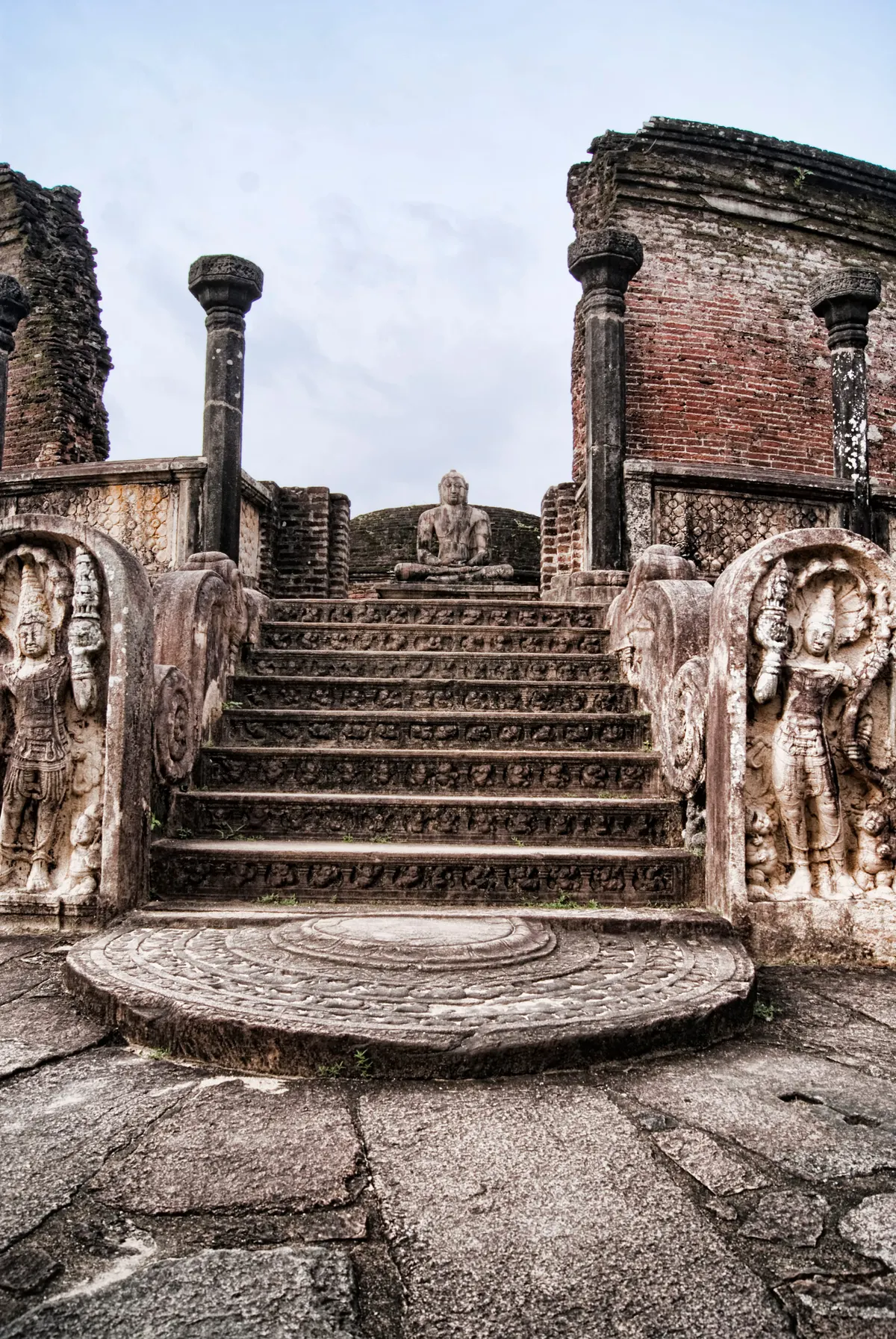
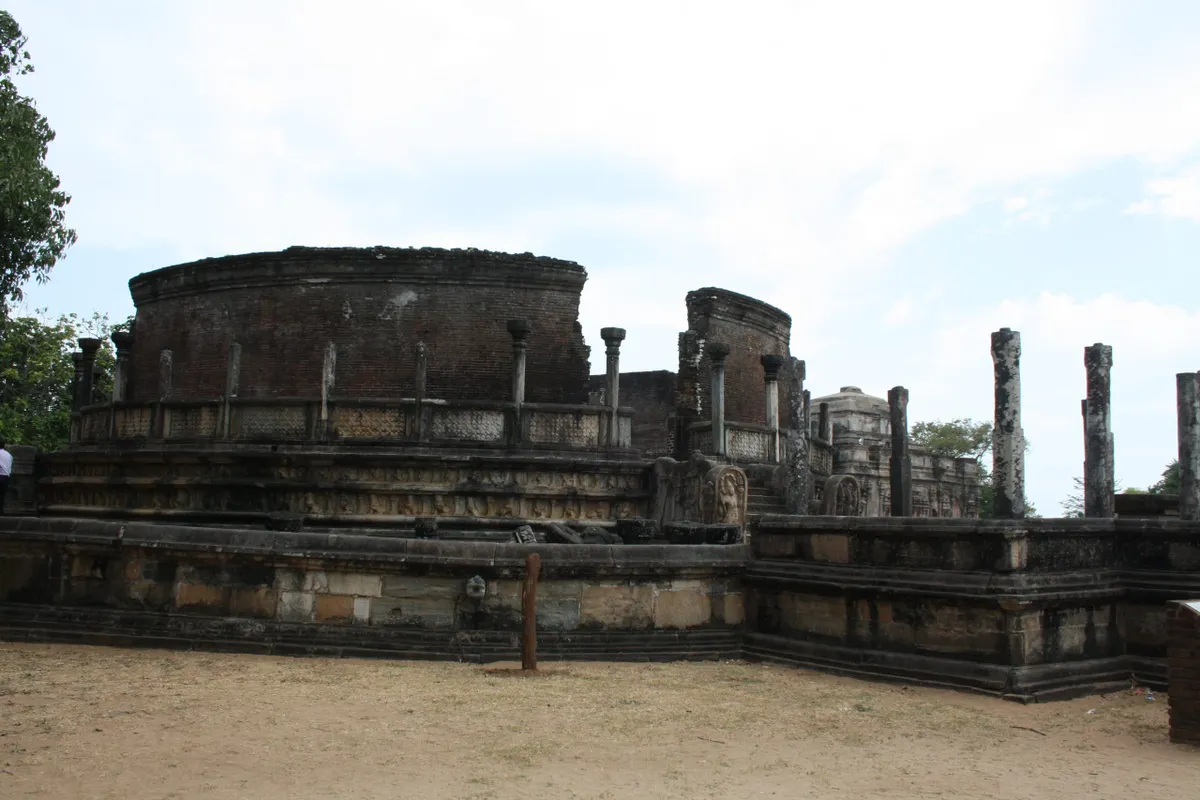
A short ride north lies the Sacred Quadrangle, the densest concentration of medieval buildings in Sri Lanka — a raised terrace packed with a dozen shrines built to house the sacred Tooth Relic. Its masterpiece is the Vatadage, a circular relic house of concentric stone terraces, each entrance guarded by a moonstone and flanked by seated Buddhas. It is perhaps the single most photogenic ruin on the island, especially in low morning light.
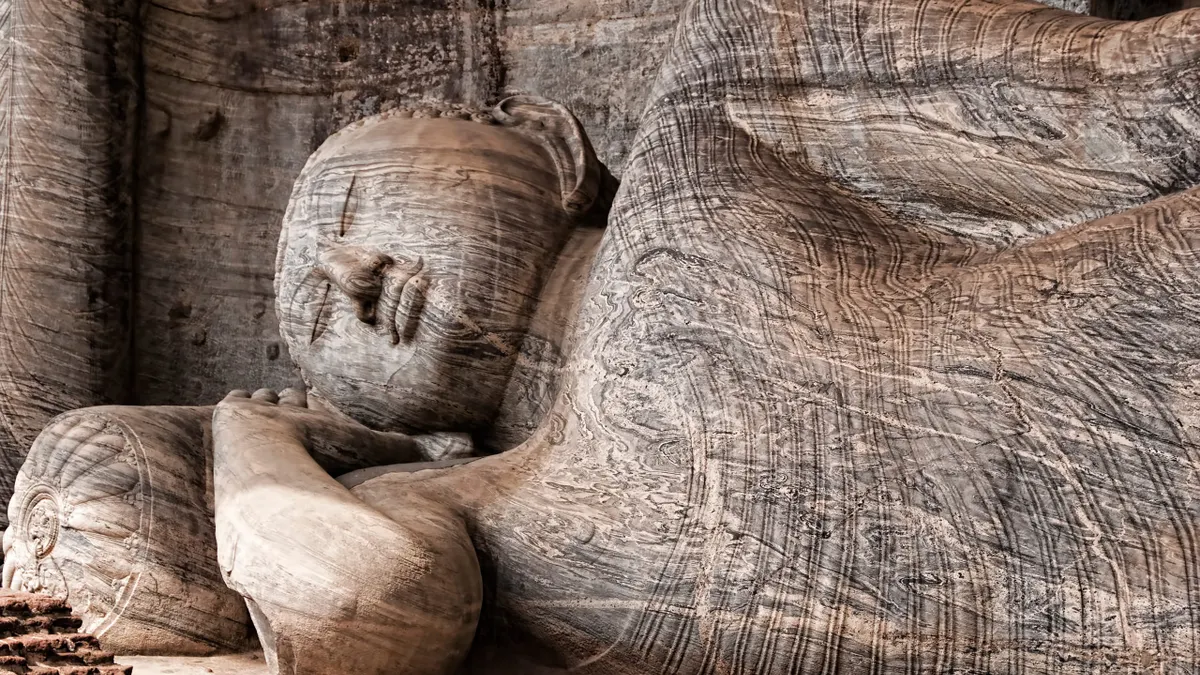
Push on north past the massive brick image houses of the Alahana Pirivena monastery to the site’s crowning glory: Gal Vihara. Here, 12th-century sculptors cut four Buddhas from a single ridge of granite — a serene seated figure, a small cave shrine, a standing image with gently crossed arms, and a 14-metre reclining Buddha entering final nirvana, the folds of his robe flowing through the natural grain of the rock. They are widely regarded as the high-water mark of Sinhalese sculpture, and no photograph quite prepares you for their presence.
Explore by bicycle
Polonnaruwa is made for two wheels. The archaeological park is flat, compact and threaded with quiet, tree-lined lanes, and a bicycle lets you cover the full south–north sweep — palace, quadrangle, monasteries, Gal Vihara and the lotus pond beyond — without ever feeling rushed. Rental bikes are easy to arrange, and freewheeling between thousand-year-old shrines with parakeets overhead is one of the Cultural Triangle’s simplest pleasures. Start early: you’ll beat both the heat and the crowds to the Vatadage.
Keep an eye on your snacks, though. Polonnaruwa’s ruins are home to large troops of toque macaques — the copper-capped monkeys made famous by wildlife documentaries filmed here. They’re endlessly entertaining to watch as they groom, squabble and sunbathe on the ancient walls, but they are accomplished thieves; keep food zipped away and bags closed.
The Sea of Parakrama
Polonnaruwa’s western edge is defined by the Parakrama Samudra — the “Sea of Parakrama” — a reservoir of more than 2,000 hectares created in the 12th century by joining older tanks into one vast sheet of water. King Parakramabahu’s dictum that “not even a drop of rain should flow into the ocean without first serving man” still defines Sri Lankan attitudes to water, and his inland sea remains in daily use nine centuries on, irrigating the surrounding rice country. Come at sunset, when fishermen pole out across the gold-lit water and the tank bund fills with strolling families — it’s the perfect closing scene to a day in the ruins.
Getting there
Polonnaruwa lies on the eastern side of the Cultural Triangle, about ninety minutes’ drive from Sigiriya and Dambulla and around five to six hours from Colombo. Most itineraries pair it with Sigiriya’s rock fortress and the sacred city of Anuradhapura over two or three days, before dropping south to Kandy. It also sits conveniently close to Minneriya and Kaudulla national parks, so an afternoon elephant safari slots neatly alongside a morning in the ruins.
Best time to visit
Like the rest of the dry-zone Cultural Triangle, Polonnaruwa is at its best from roughly January to September, when days are hot and reliably bright. The northeast monsoon can bring rain between December and February, though showers rarely last long. Whatever the month, structure your day around the heat: ruins in the early morning, a long lunch and a swim through midday, and Gal Vihara or the reservoir bund for the soft late-afternoon light.
Know before you go
The site is spread out enough that you’ll want transport — bicycle, tuk-tuk or car — and a guide genuinely earns their fee here, animating the stones with the politics and engineering of the medieval court. Dress modestly and be prepared to remove shoes and hats at the shrines, including at Gal Vihara, where the sand can scorch bare feet by mid-morning; pack socks. Carry water, and remember that turning your back to a Buddha image for a photo is considered disrespectful.
See Polonnaruwa at its golden-hour best on our Classic Ceylon 7-day journey — the Cultural Triangle, done properly.